
Basement Floor Coating in Oklahoma City: The Complete Homeowner’s Guide
Most Oklahoma City homeowners don’t think much about their basement floor until there’s a problem — moisture seeping up through the slab, a previous coating peeling in sheets, or a surface so stained and pitted it can’t be cleaned no matter what you use. At that point, the question isn’t whether to do something about it, but what to do and who to trust with it.
This guide covers everything you need to know about basement floor coating in Oklahoma City — why basements are uniquely challenging, what coating options are available, and which system consistently performs best in Oklahoma’s soil and climate conditions.
Why Oklahoma City Basements Are Harder to Coat Than You’d Think
Basements in Oklahoma City deal with a specific set of conditions that make surface coating more demanding than a standard garage or patio project.
The red clay soil underlying most of the OKC metro is one of the most expansive in the country. It swells when saturated and shrinks sharply during dry periods, driving moisture vapor up through the concrete slab even when there’s no visible water intrusion. This moisture vapor emission is the leading cause of basement coating failures in Oklahoma — any system that can’t tolerate it will bubble, delaminate, and fail within a few years. Oklahoma basements also experience seasonal slab expansion and contraction, and a rigid coating that can’t flex with that movement will crack at stress points, creating new pathways for moisture.
Basement Floor Coating Options
Paint and Masonry Sealers
Paint is not a coating system — it’s a film that sits on top of concrete without bonding to it at any meaningful depth. In a basement environment with moisture vapor pressure from below, paint peels within one to three years without exception. Masonry sealers offer marginally better protection but still require annual reapplication and provide no real defense against the moisture conditions Oklahoma basements experience.
Neither is a long-term solution.
Epoxy Coatings
Epoxy is widely marketed for basement floors and has legitimate strengths — it bonds to properly prepared concrete, offers decent chemical resistance, and comes in a variety of colors and decorative finishes. But in Oklahoma City basements specifically, epoxy has a well-documented failure pattern.
The core problem is moisture sensitivity. Epoxy cannot tolerate significant moisture vapor emission during or after application. In Oklahoma’s clay-heavy soil environment, this is almost always present to some degree. The result is bubbling and delamination that starts within one to two years and progresses until the entire coating has separated from the slab. A homeowner who paid for a professional epoxy installation finds themselves pulling it up and starting over — at full cost again.
Epoxy also requires five to seven days of cure time before the space can be used — a significant disruption for a basement that’s part of daily home life.
Polyurea and Polyaspartic Systems
Polyurea solves the moisture problem that makes epoxy fail in Oklahoma basements. Its chemistry tolerates elevated moisture vapor emission during application — meaning it bonds properly even when the slab has the kind of vapor pressure that would cause epoxy to fail. The Portland Cement Association identifies moisture and temperature cycling as the two primary drivers of concrete coating failure, and polyurea’s design addresses both directly.
The polyurea base coat is also elastomeric — it flexes with the concrete slab through seasonal movement rather than cracking at stress points. Paired with a polyaspartic topcoat, the system delivers chemical resistance, impact resistance, and a finished appearance that holds up for fifteen to twenty-five years under normal residential use.
At ICS Concrete Coatings, we install Penntek polyurea and polyaspartic systems exclusively on basement floors. It’s the system that holds up in Oklahoma’s conditions — not just in the first year, but in year ten and beyond.
Surface Preparation: The Step That Determines Everything
No coating system performs well on improperly prepared concrete, and basements are where skipped prep steps cause the fastest failures.
Professional basement floor preparation starts with diamond grinding — industrial grinding equipment that opens the pores of the concrete and creates a mechanical surface profile the polyurea base coat can bond to. Without this step, even the best coating sits on top of the concrete rather than bonding to it, and it will eventually separate under Oklahoma’s moisture and temperature conditions.
Moisture vapor testing is critical for basements specifically. Before any coating goes down, a professional measures the slab’s moisture vapor emission rate. If it’s too high for the planned system, the project stops until the issue is addressed — not after the coating has been applied and failed. According to the EPA, uncontrolled moisture is the leading cause of structural surface failures in below-grade spaces.
Crack and spall repair follows — any damaged areas are filled, ground flush, and made structurally sound before the coating goes down. Applying a coating over unrepaired damage doesn’t fix the damage; it hides it temporarily until the coating fails at those points.
Finish Options for Basement Floors
A properly coated basement floor doesn’t have to look industrial. The same chip and solid-color finish systems available for garages and patios work equally well in basement environments, and the right finish can make the space feel like an intentional part of the home rather than an afterthought.
Chip finishes — vinyl flake broadcast into the base coat and sealed under the topcoat — are the most popular choice for basements used as living spaces, home gyms, playrooms, or workshops. The multi-color patterns hide dirt and debris between cleanings, the textured surface adds grip, and the variety of available blends means the finish can complement the rest of the home’s aesthetic. You can browse the full range on our color and finishes page.
Solid color finishes offer a cleaner, more contemporary look for basements where the aesthetic goal is a polished, finished appearance. Light neutrals are popular for brightening a space that typically has limited natural light.
Both options are completed in a single day and ready for use within twenty-four hours — a significant advantage over epoxy’s five to seven day cure window.
What to Expect from the Installation
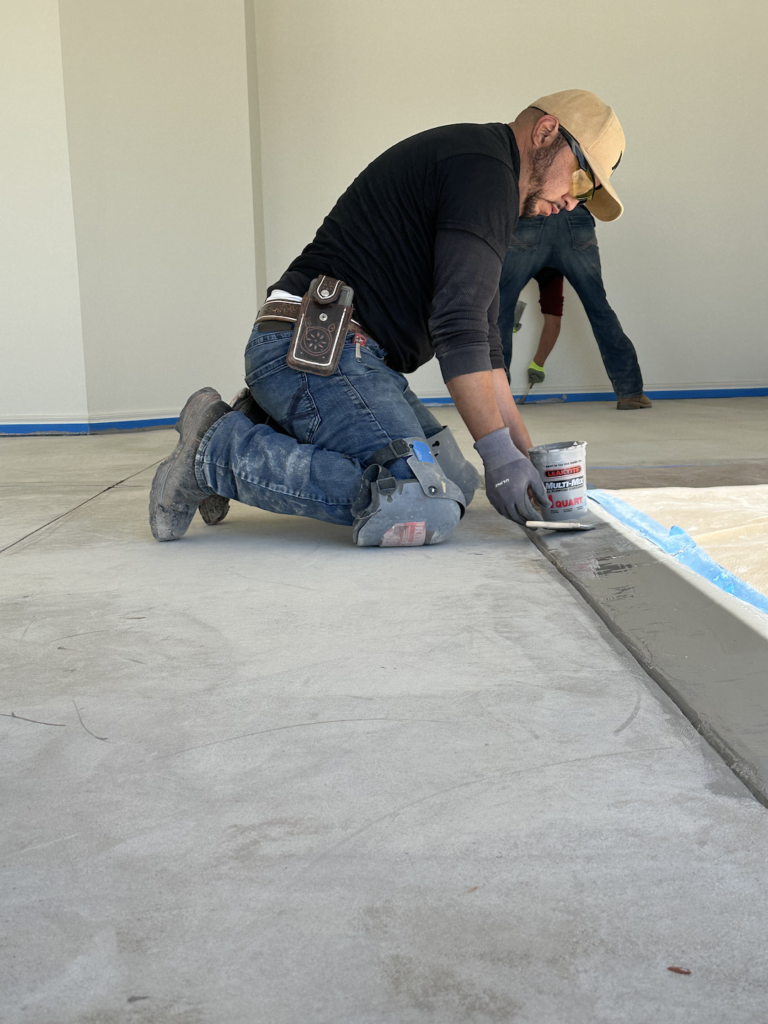
Every ICS installation follows the same process: site assessment, diamond grinding, moisture testing, crack repair, polyurea base coat, chip or solid color broadcast, and polyaspartic topcoat — all in one day. The floor is ready for foot traffic within four to six hours and fully usable within twenty-four hours. Our full residential process is on our residential services page.
Frequently Asked Questions
Why do epoxy basement floors fail in Oklahoma City? The primary cause is moisture vapor emission from the slab. Oklahoma’s clay soil creates consistent vapor pressure in basement slabs, and epoxy cannot bond properly over elevated moisture. The coating appears fine initially but begins to bubble and delaminate within one to two years as moisture works beneath it. Polyurea tolerates this moisture during application and maintains its bond long-term.
How long does a basement floor coating last? A professionally installed polyurea and polyaspartic system lasts fifteen to twenty-five years under normal residential use. The Penntek system ICS installs carries a limited lifetime warranty for residential applications.
How much does basement floor coating cost in Oklahoma City? A professional polyurea and polyaspartic installation typically runs $6 to $10 per square foot. For a standard basement of 800 to 1,000 square feet, most homeowners are looking at $4,800 to $10,000 depending on the finish selected and the condition of the existing concrete. A site assessment gives an accurate quote before any commitment is made.
Can a basement floor be coated if it has existing moisture issues? It depends on the severity. Surface moisture and normal vapor emission are within the tolerance range of polyurea systems. Active water intrusion — water coming through the walls or pooling on the floor during rain — needs to be addressed at the source before any coating is applied. A site assessment will identify which situation you’re dealing with.
How disruptive is the installation? Most residential basement floor projects are completed in a single day. The space needs to be fully cleared before installation begins, and normal use resumes within twenty-four hours. Compared to epoxy’s five to seven day cure window, polyurea’s fast return-to-service is a meaningful practical advantage for a space that’s part of daily home life. OSHA’s guidance on indoor surfaces also recognizes fast-cure sealed floors as lower-disruption solutions for occupied spaces.
Ready to Get Started?
Get your free quote today. We’ll assess your basement floor, walk you through your finish options, and give you a detailed proposal — no pressure, no obligation.
Or call us directly at (405) 403-4012
We serve homeowners across Oklahoma City, Edmond, Norman, Moore, Broken Arrow, Tulsa, and the surrounding areas.
Author: Steven Smith