
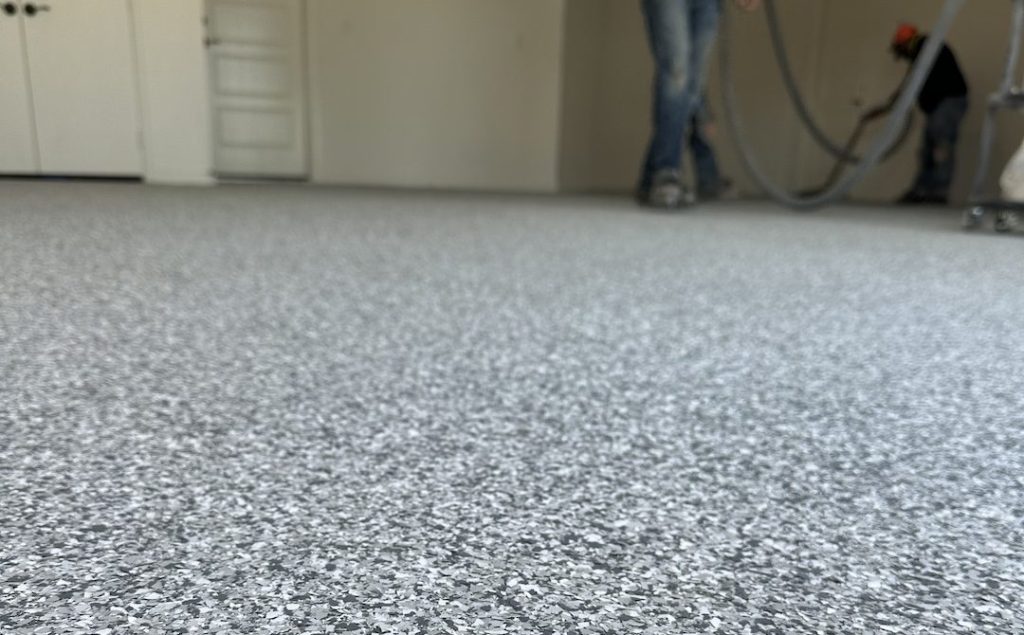
Coating for Concrete: The Complete Homeowner’s Guide to Choosing the Right Floor
If your concrete floor is stained, cracking, or just plain ugly, you’ve probably started looking into coatings — and quickly discovered there are a lot of options. Epoxy, polyurea, polyaspartic, paint, stain, sealer. Every product claims to be the best.
This guide cuts through the noise. We’ll walk you through every major coating for concrete, what each one does well, where each one falls short, and which system consistently outperforms the rest for homeowners here in Oklahoma.
What Does a Concrete Coating Actually Do?
Concrete is naturally porous, which means it absorbs oil, water, and chemicals over time. It cracks under temperature swings, stains easily, and never really looks clean. A good coating for concrete seals that surface and does five things: protects the slab from moisture and chemicals, strengthens the surface under heavy use, seals pores so stains can’t penetrate, improves safety through slip resistance, and looks good for years — not just months.
The coating you choose determines how well it does all five, and for how long.
The Main Types of Concrete Coatings
Latex and Masonry Paint
Paint is not a coating — it’s a film. It sits on top of concrete without bonding to it at any real depth. Within one to three years, it peels, chips, and flakes. It offers almost no protection against oil, UV exposure, or moisture. Most professionals won’t even quote it as a serious option.
Concrete Stain
Stains create beautiful, one-of-a-kind decorative effects, but they color the concrete rather than protect it. A stained floor still needs a topcoat sealer to hold up under real-world use. Stains work well in indoor decorative spaces where aesthetics are the priority, but they aren’t a standalone flooring solution.
Concrete Sealer
Sealers are a maintenance product, not a flooring system. They protect against moisture and minor staining but won’t hide surface damage, add meaningful thickness, or hold up under vehicle traffic or chemical exposure. Best suited for driveways and exterior slabs where waterproofing is the main goal.
Epoxy Coatings
Epoxy is legitimately better than paint or sealer. It bonds to properly prepared concrete, offers real chemical resistance, and comes in a wide range of colors and finishes including popular decorative flake systems. But epoxy has well-documented weaknesses that matter a lot for homeowners:
- Moisture sensitivity: Epoxy fails over concrete with high moisture vapor emission — a common issue in Oklahoma basements and slabs on grade. Moisture causes bubbling and peeling.
- UV degradation: Standard epoxy yellows and fades in sunlight, making it a poor choice for patios or any outdoor surface.
- Long cure times: Epoxy typically takes 24 to 72 hours to walk on and five to seven days before you can drive on it.
- Brittleness: Once cured, epoxy is rigid. As concrete naturally expands and contracts with Oklahoma’s temperature swings, epoxy cracks at stress points.
Epoxy works best in dry, indoor, controlled environments — but it isn’t the right answer for most Oklahoma homes.
Polyurea Coatings
Polyurea fixes nearly every weakness epoxy has. It’s elastomeric, meaning it flexes with the concrete rather than cracking under movement — critical in a state where temperatures swing from 10°F to 110°F. It tolerates elevated moisture levels during application, cures in two to four hours, and resists oil, gasoline, brake fluid, and household chemicals better than epoxy. It’s also one of the strongest choices for slip-resistant flooring in high-traffic home areas like garages and utility spaces.
The tradeoff is that polyurea cures so fast it’s nearly impossible to apply correctly without professional equipment. This is a professional-install product, and the results reflect that.
Polyurea + Polyaspartic Systems
Polyaspartic is a modified form of polyurea with one critical addition: UV stability. It doesn’t yellow, chalk, or fade in sunlight, making it the right topcoat for patios, pool decks, driveways, and any surface exposed to the Oklahoma sun.
A polyurea base coat paired with a polyaspartic topcoat is the highest-performing system available for residential concrete floors. It combines maximum adhesion, flexibility, chemical resistance, and UV stability — all installed in a single day.
How Much Does Concrete Coating Cost?
Polyurea costs more upfront than epoxy — but if epoxy needs replacing every five to seven years and polyurea lasts twenty-plus, the epoxy floor costs more over time. Factor in the disruption of losing your garage or patio again for a week-long reinstall every few years, and the math shifts quickly.
Surface Preparation: The Step That Determines Everything
No coating performs well on improperly prepared concrete. According to The Concrete Network, surface prep is the single most important factor in how long a floor coating lasts. Proper prep includes diamond grinding to open the concrete’s pores and create a surface the coating can mechanically bond to, moisture testing to catch vapor emission issues before they cause failures, crack and spall repair to address damage before it’s covered, and degreasing to remove contamination that prevents adhesion.
If someone quotes you a coating job without mentioning surface prep in detail, that’s a red flag.
Frequently Asked Questions
What is the best coating for a concrete garage floor? For most Oklahoma homeowners, a polyurea base coat with a polyaspartic topcoat is the right answer. It handles moisture, cures the same day, flexes with the slab through temperature changes, and resists oil and UV fading. It outlasts epoxy by a decade or more. See our residential flooring page for more on what this looks like for garages and basements.
How long does concrete floor coating last? Paint lasts one to three years. Epoxy typically lasts five to ten years under ideal conditions. Professional polyurea and polyaspartic systems routinely last fifteen to twenty-five years.
Can I coat my concrete patio or pool deck? Yes — but the coating must be UV stable. Standard epoxy is a poor choice outdoors. Polyaspartic coatings are built for UV resistance and are the correct choice for any surface exposed to direct sunlight. Learn more on our outdoor surfaces page.
Will the coating crack if my concrete shifts? Polyurea and polyaspartic coatings flex rather than crack when concrete moves. Epoxy, being rigid, is far more prone to cracking at slab joints — especially in Oklahoma’s climate.
Is one-day installation really possible? With polyurea and polyaspartic systems, yes. The floor is typically ready for foot traffic within a few hours and full vehicle traffic within twenty-four hours.
Why ICS Concrete Coatings Uses Polyurea and Polyaspartic
We’ve seen what happens when the wrong product goes down on an Oklahoma floor. The temperature swings here are brutal on rigid coatings. The moisture in our soil creates vapor pressure that destroys improperly prepared epoxy. The UV exposure fades surfaces that aren’t built to handle it.
That’s why we exclusively install polyurea and polyaspartic systems — not because they’re trendy, but because they’re the right answer for this climate and these conditions.
Every installation starts with diamond grinding and moisture testing, includes full crack and spall repair, and is completed in a single day. Our floors are built to last decades, not years.
Ready to Get Started?
Get your free quote today. We’ll assess your concrete, answer your questions, and give you a detailed proposal — no pressure, no obligation.
Or call us directly at (405) 403-4012
We serve homeowners across Oklahoma City, Tulsa, Edmond, Norman, Moore, Broken Arrow, and the surrounding areas.
Author: Steven Smith