Concrete Resurfacing: What It Is, How It Works, and When It’s the Right Choice
If your garage floor is cracked, your driveway is stained, or your patio looks like it’s been through a decade of Oklahoma weather, you might be thinking it’s time to tear it all out and start fresh. In most cases, you don’t have to. Concrete resurfacing can completely transform a worn slab at a fraction of the cost of replacement — and when it’s done with the right system, it outperforms the original surface.
What Is Concrete Resurfacing?
Concrete resurfacing is the process of restoring an existing concrete surface rather than removing and replacing it — a method backed by research from organizations like the American Concrete Institute. Instead of jackhammering out your old slab — a costly, disruptive process — resurfacing repairs the damage, strengthens the surface, and applies a protective system that improves both performance and appearance.
Done correctly, concrete resurfacing repairs surface cracks and chips, creates a smooth and uniform finish, seals the slab against moisture and chemical penetration, and adds years — sometimes decades — of additional life to an existing surface.
It’s not a cosmetic band-aid. It’s a structural upgrade.
Why Concrete Deteriorates in the First Place
Understanding why concrete breaks down helps you choose the right fix. In Oklahoma, concrete takes a beating from multiple directions at once.
Temperature swings are the biggest culprit. Concrete naturally expands in heat and contracts in cold. Over years of Oklahoma summers and winters, that repeated movement creates stress fractures that start small and spread. Once a crack forms, water gets in — and water is the accelerant. Moisture works into the slab, freezes, expands, and widens the damage from the inside out.
Add UV exposure, vehicle traffic, and oil spills, and deterioration becomes inevitable without proper surface protection.
Signs Your Concrete Is Ready for Resurfacing
The earlier you address surface damage, the less expensive and disruptive the fix. These are the signs that concrete resurfacing is the right next step:
Hairline or spreading cracks are one of the earliest indicators — small cracks are pathways for water to penetrate the slab. Surface pitting or a rough texture means the top layer has begun breaking down from freeze-thaw cycles. Staining that won’t clean out signals the surface has lost its protective density. Peeling or bubbling from a previous coating means it’s failed and needs proper prep and recoating. Fading or discoloration outdoors usually points to UV damage.
If your concrete has any of these, resurfacing now is almost always cheaper than waiting.
When Resurfacing Makes Sense — and When It Doesn’t
Resurfacing works when the slab itself is structurally sound — surface damage, staining, and minor cracking are all fair game. Replacement makes more sense when there are deep through-cracks, major shifting, or a base that has eroded. A professional assessment will tell you which category you’re in.
Concrete Resurfacing Methods: What’s Available
Not all resurfacing systems are created equal, and the method you choose determines how long the results last.
Cement-based overlays are a traditional option that improve the appearance of a surface and fill in minor imperfections. They’re relatively affordable but have a significant weakness — they’re rigid, which means they crack under the same temperature-driven movement that damaged your original concrete. In Oklahoma’s climate, cement overlays often fail within a few years.
Epoxy coatings are a step up from cement overlays. They bond directly to the concrete, offer decent chemical resistance, and come in a wide variety of colors and decorative finishes. However, epoxy is also rigid, yellows under UV exposure, and requires several days to fully cure. For outdoor surfaces like patios and driveways, standard epoxy is a poor long-term choice.
Polyurea and polyaspartic systems are where resurfacing technology has genuinely advanced. These coatings are elastomeric — they flex with the concrete as it expands and contracts — which means they don’t crack under the same conditions that destroy epoxy and cement overlays. They bond aggressively to properly prepared concrete, cure within hours rather than days, and resist moisture, chemicals, UV exposure, and heavy traffic better than any other system available.
For Oklahoma homeowners dealing with real weather, real vehicle traffic, and real conditions, polyurea and polyaspartic systems are consistently the right answer.
Why Polyurea Outperforms Everything Else for Resurfacing
The core problem with most resurfacing failures is rigidity. When a coating can’t move with the slab, it eventually separates from it. Polyurea eliminates that problem by design. Its elastomeric chemistry means it bonds to the concrete and stays bonded even as the slab moves through seasonal temperature cycles.
Beyond flexibility, polyurea and polyaspartic systems offer same-day cure times — your garage or patio is back in service within hours, not a week. They’re seamless and waterproof, meaning moisture can’t find its way in through seams or joints. They resist oil, gasoline, and household chemicals without staining or degrading. Anti-slip aggregates can be incorporated into the topcoat to meet OSHA’s walking-working surfaces standards for safe, non-slip floors. And when a polyaspartic topcoat is applied over a polyurea base, the system becomes UV stable — no yellowing, no fading, no chalking, even on surfaces in direct Oklahoma sun year-round.
This is why ICS Concrete Coatings uses polyurea and polyaspartic exclusively — because it’s the system that holds up when everything else doesn’t.
The Importance of Surface Preparation
The most common reason resurfacing fails — with any system — is inadequate surface preparation. A coating applied to contaminated, improperly profiled, or moisture-compromised concrete will fail no matter how good the product is.
Professional concrete resurfacing always starts with diamond grinding to mechanically open the pores of the slab and create a surface profile the coating can bond to. It includes moisture vapor testing to catch any emission issues that would cause bubbling or delamination — the EPA notes that uncontrolled moisture in concrete slabs is one of the leading causes of floor covering failures. Cracks and spalled areas are repaired and ground flush before anything goes over them. Contaminants like oil and grease are chemically treated and removed.
At ICS Concrete Coatings, prep work is never rushed — it’s how a job that should last twenty years doesn’t fail in two.
Concrete Resurfacing for Garages, Patios, and Driveways
The right resurfacing approach varies slightly depending on where the concrete is and how it’s used.
For garages, the priority is chemical resistance and durability under vehicle traffic. Oil, gasoline, and brake fluid are constant threats. A polyurea base with a polyaspartic topcoat handles all of it while curing fast enough that you’re not locked out of your garage for days. Our residential flooring services cover everything a homeowner needs for an interior slab.
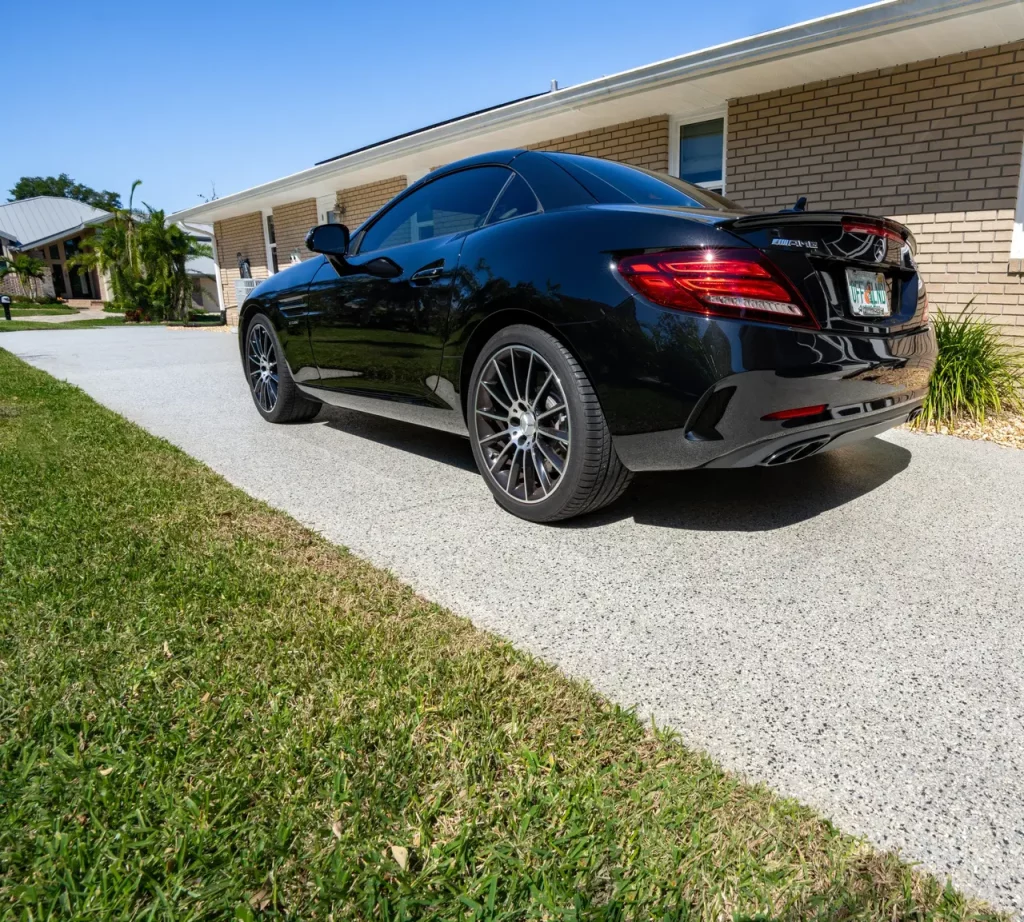
For patios and driveways, UV stability is the top requirement. Any system that can’t handle direct sunlight will yellow and fade within a season or two in Oklahoma. Polyaspartic topcoats are specifically formulated for this — they maintain their color and gloss outdoors for years. See our outdoor surfaces page for more on what this looks like in practice.
Frequently Asked Questions
How long does concrete resurfacing last? It depends on the system. Cement overlays may last three to five years in Oklahoma’s climate. Epoxy typically lasts five to ten years under good conditions indoors. A professionally installed polyurea and polyaspartic system can last fifteen to twenty-five years with minimal maintenance.
Can you resurface concrete with cracks? Yes — surface cracks and minor structural cracks can be repaired as part of the resurfacing process. The cracks are filled, ground flush, and then the coating system is applied over the repaired surface. Deep structural cracks that go all the way through the slab may indicate the concrete needs replacement rather than resurfacing.
How much does concrete resurfacing cost? Cost varies based on the system used, square footage, and condition of the existing concrete. Basic epoxy systems typically run $3 to $8 per square foot. Professional polyurea and polyaspartic systems generally range from $6 to $10 per square foot — more upfront, but significantly longer-lasting, which lowers the cost over time.
How long does the installation take? With polyurea and polyaspartic systems, most residential projects are completed in a single day — ready for foot traffic within hours and vehicle traffic within twenty-four hours. Epoxy requires five to seven days.
Can you resurface an outdoor patio or driveway? Yes, but the system must be UV stable. Standard epoxy yellows and degrades quickly outdoors. Polyaspartic coatings are built specifically for UV resistance and are the right choice for any exterior surface.
Ready to Resurface Your Concrete?
Get your free quote today. We’ll assess your slab, answer your questions, and give you a detailed proposal — no pressure, no obligation.
Or call us directly at (405) 403-4012
We serve homeowners across Oklahoma City, Tulsa, Edmond, Norman, Moore, Broken Arrow, and the surrounding areas.
Author: Steven Smith