
Chip Floor Finishes for Garage Concrete Coating: A Complete Guide for Oklahoma Homeowners
Your garage floor takes more abuse than almost any surface in your home. Vehicle traffic, oil drips, chemical spills, dropped tools, and Oklahoma’s relentless temperature swings add up — and bare concrete wasn’t built to handle all of it indefinitely. Chip floor finishes are one of the most effective upgrades available for garage concrete because they address every one of these problems while turning an overlooked space into something worth showing off.
This guide covers everything Oklahoma homeowners need to know about chip floor finishes for garage concrete — how they work, what makes them hold up, what the installation looks like, and how to choose the right system.
What Makes Chip Floor Finishes Different from Other Garage Coatings
Chip floor finishes — also called flake or broadcast chip systems — layer colored vinyl chips between a base coat and a protective topcoat. That sandwich construction is what separates chip finishes from paint, basic sealers, or solid-color epoxy systems.
Paint sits on top of concrete without bonding to it in any meaningful way. It peels, chips, and fades within a year or two under garage conditions. Solid-color epoxy bonds better but leaves a smooth, featureless surface that shows every tire mark and scratch.
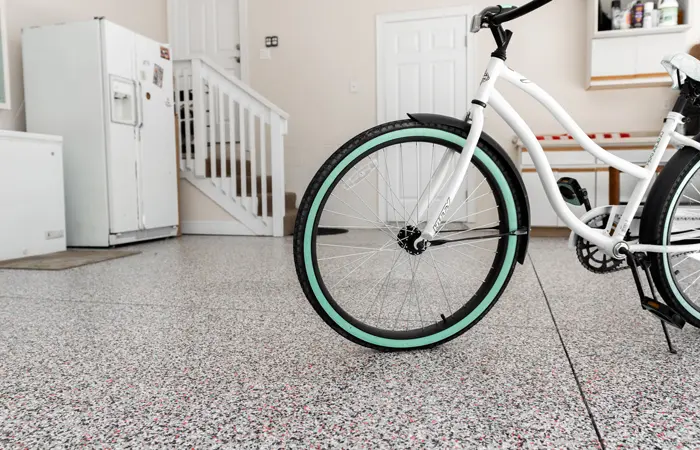
Chip floor finishes are different because the chips create a textured, multi-color surface that hides imperfections, distributes wear evenly, and adds visible depth that makes the floor look like a finished product rather than a painted slab. The texture also adds grip — a real safety benefit in a space where oil and water regularly end up on the floor.
The Coating System Under the Chips Is What Determines Performance
Most homeowners focus on the color and chip blend when choosing a garage floor finish. That matters — but the chemistry of the base coat and topcoat is what determines how long the system holds up, how quickly it cures, and whether it survives Oklahoma’s climate.
Epoxy base coat systems are the most commonly marketed option and the most commonly replaced. In Oklahoma garages, epoxy has three predictable failure points. It’s rigid, so it cracks when the concrete slab shifts with seasonal temperature changes. It’s sensitive to moisture vapor coming up through the slab — a common issue in Oklahoma City — which causes bubbling and delamination. And it yellows under UV exposure, degrading the finish in any garage with natural light or an open door.
Polyurea base coat systems with polyaspartic topcoats eliminate all three failure points. The elastomeric polyurea base flexes with the concrete rather than cracking against it. It can be applied even when the slab has elevated moisture levels. The polyaspartic topcoat is UV stable — it doesn’t yellow, chalk, or fade regardless of sun exposure. According to the American Concrete Institute, flexibility and moisture tolerance are the two most critical properties for concrete coating longevity, which is exactly what polyurea delivers.
At ICS Concrete Coatings, every chip floor finish we install uses the Penntek polyurea and polyaspartic system. It’s a more durable platform than epoxy-based chip systems, and the results reflect it.
What to Expect from the Installation
A professionally installed chip floor finish for a standard two-car garage is typically completed in a single day, with the floor ready for foot traffic within hours and vehicle traffic within twenty-four hours. Here’s how the process works.
The installation begins with surface preparation — the step that determines everything. We diamond grind the entire garage floor to open the concrete’s pores and create a surface profile the base coat can mechanically bond to. Any existing cracks, spalls, or damaged areas are repaired and ground flush before the coating goes down. The floor is then checked for moisture vapor emission, which is critical in Oklahoma’s clay-heavy soil environment where vapor pressure from below is a common cause of coating failure.
With prep complete, the polyurea base coat is applied. While it’s still wet, the vinyl chips are broadcast across the surface — full broadcast for dense, even coverage, or partial broadcast for a lighter, more speckled appearance. Once the base coat cures, the excess chips are scraped away, the surface is cleaned, and the polyaspartic topcoat is applied to seal everything in.
The whole process is completed in one visit. By the next morning, you have a fully functional, professionally finished garage floor. You can explore the full range of chip blends and colors available on our color and finishes page.
Choosing the Right Chip Blend for Your Garage
The chip blend affects both the look of the finished floor and how it performs in a working garage environment.
Multi-color blends with medium to dark tones do the best job concealing tire marks, rubber transfer, and everyday dirt between cleanings — a practical consideration for a heavily used garage. Lighter blends brighten dark garage interiors and make the space feel larger, but show more debris day-to-day. Natural stone blends (grays, tans, and earth tones) are the most versatile and tend to look current regardless of when they were installed.
Coverage density is also a choice. Full broadcast chip coverage creates a denser, more uniform surface with maximum texture and grip. Partial broadcast leaves visible base coat color between the chips, creating a more open, terrazzo-like appearance. Both are durable options — the choice comes down to the aesthetic you’re after.
Maintenance: What a Chip Floor Finish Requires
One of the main reasons homeowners choose chip floor finishes over other garage flooring options is how little maintenance they need. The seamless, non-porous surface resists dirt, oil, and moisture at the surface level — spills don’t penetrate, they pool on top until cleaned up.
Day-to-day maintenance is a sweep or vacuum to remove abrasive debris. For deeper cleaning, a mop with warm water and a pH-neutral cleaner handles oil, road grime, and most chemical spills without special products or equipment. The EPA’s Safer Choice program recommends certified safer cleaning products for sealed concrete surfaces — most common household floor cleaners qualify.
A professionally installed polyurea and polyaspartic chip floor doesn’t need waxing, resealing, or periodic topcoat refreshes under normal garage use. The system is designed to maintain its appearance and performance for fifteen to twenty-five years. See finished examples in our project gallery.
Frequently Asked Questions
How long do chip floor finishes last in an Oklahoma garage? With a polyurea and polyaspartic system, fifteen to twenty-five years is typical under normal residential use. Epoxy-based chip systems perform less reliably in Oklahoma’s climate — most homeowners see cracking, peeling, or yellowing within five to ten years due to the moisture and temperature conditions here.
Can a chip floor finish be applied over an existing epoxy floor? The existing coating needs to be ground away before a new chip floor finish is installed. Applying a new system over a failing or peeling existing coating transfers the failure to the new layer. Diamond grinding removes the old coating and prepares the surface for proper adhesion.
How much does a chip floor finish cost for a garage in Oklahoma City? A professionally installed polyurea and polyaspartic chip system typically runs $6 to $10 per square foot. For a standard two-car garage of around 500 square feet, most homeowners are looking at $3,000 to $5,000. That’s more than a DIY epoxy kit — but a polyurea system installed correctly doesn’t need to be replaced every five to seven years, which changes the math over time.
Is chip flooring slippery when wet? No — the textured surface created by the chips adds grip that smooth concrete and solid-color coatings don’t provide. Anti-slip aggregate can also be added to the topcoat for additional traction in wet conditions, which is why chip floors are commonly specified for OSHA-compliant walking-working surfaces in commercial and industrial environments.
How soon can I use my garage after the chip floor is installed? With a polyurea and polyaspartic system, most residential garage floors are ready for foot traffic within four to six hours and vehicle traffic within twenty-four hours of the final topcoat. Epoxy systems typically require five to seven days of cure time before the floor can handle vehicle weight.
Ready to Get Started?
Get your free quote today. We’ll assess your garage floor, walk you through your chip blend options, and give you a detailed proposal — no pressure, no obligation.
Or call us directly at (405) 403-4012
We serve homeowners across Oklahoma City, Edmond, Norman, Moore, Broken Arrow, Tulsa, and the surrounding areas.
Author: Steven Smith
Recent Posts
- Skim Coat for Concrete: What It Is & When You Need It
- Polyurea Pool Deck Coating in Oklahoma City: What It Is and Why It Performs
- The Top Benefits of Commercial Polyurea Flooring for Oklahoma Businesses
- Modern Concrete Paver Walkway Ideas for Oklahoma Homes: What Works and What Lasts
- Useful Gifts For Mother’s Day: A Polyurea Patio from ICS Concrete Coatings