
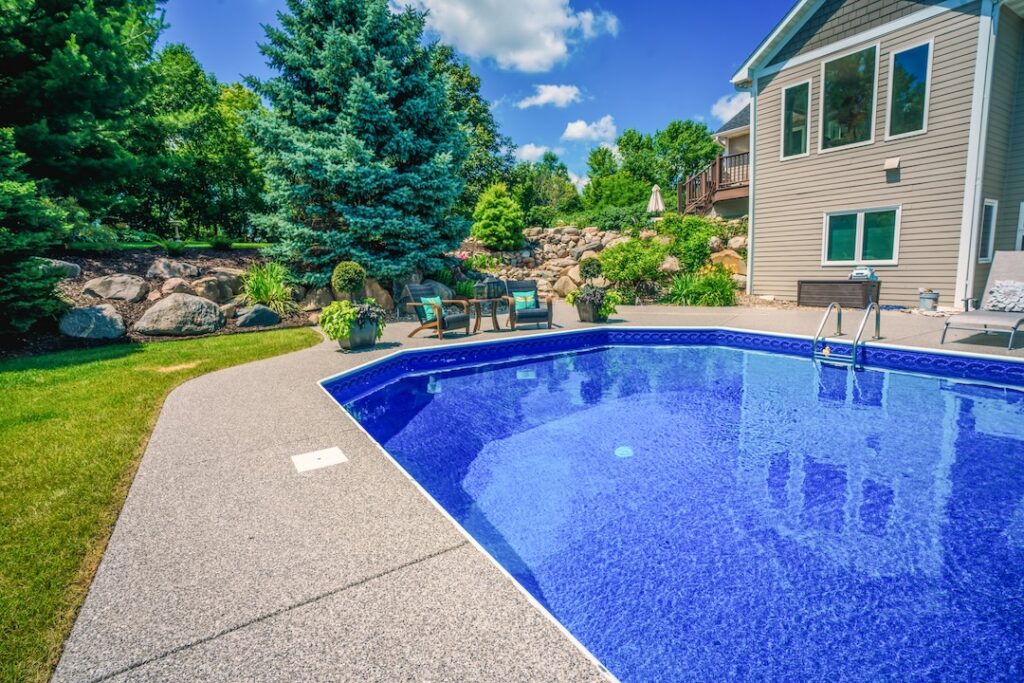
Pool Deck Coating in Oklahoma City: What Works, What Doesn’t, and How to Choose
Your pool deck takes more abuse than almost any other surface around your home — wet constantly, baking in direct Oklahoma sun, walked on with bare feet, and exposed to chlorine and pool chemicals. Most uncoated or improperly sealed pool decks in Oklahoma City show their age fast: cracking, staining, fading, and becoming a slip hazard within a few seasons. This guide covers what Oklahoma City homeowners need to know before choosing a pool deck coating — what the options are, what holds up here, and what to look for in a system that stays safe and looks good for years.
Why Oklahoma Pool Decks Deteriorate Faster Than You’d Expect
Oklahoma’s climate is genuinely hard on outdoor concrete. The combination of intense UV exposure, dramatic temperature swings, and the clay-heavy soil that shifts under slabs creates conditions that accelerate surface deterioration faster than in more moderate climates.
UV exposure is the first factor. Oklahoma City averages over 230 sunny days a year, and pool decks sit in full sun for most of them. Any coating without UV-stable chemistry will yellow and degrade within one to two seasons.
Temperature swings are the second factor. Concrete expands in Oklahoma’s summer heat and contracts in winter cold — differentials of 100°F or more. A coating that can’t flex with that movement cracks at stress points, creating pathways for water infiltration.
Chlorine and pool chemicals complete the picture. Pool water carries chlorine and algaecides that degrade standard sealers and epoxy coatings over time. A pool deck coating needs genuine chemical resistance.
The Difference Between a Sealer and a Coating
These terms get used interchangeably in the market, but they describe different products with very different performance levels.
A concrete sealer is a penetrating or film-forming product that protects bare concrete from moisture and minor staining. Sealers require reapplication every one to three years and offer limited protection against the UV, chemical exposure, and physical wear pool decks experience. They’re a maintenance product — not a long-term solution.
A polyurea and polyaspartic coating system bonds to the concrete at a structural level, creates a seamless protective membrane, and resists UV, chemicals, moisture, and abrasion for fifteen to twenty-five years without resealing. It’s a fundamentally different product category, even though both are sometimes called “pool deck sealers.” For Oklahoma City homeowners who want minimal ongoing maintenance, a coating system is the right investment.
What Pool Deck Coating Options Are Available
Standard Epoxy
Epoxy is one of the most widely marketed pool deck products and one of the most commonly replaced. In Oklahoma’s outdoor conditions it fails predictably — it yellows without UV stability, cracks because it’s rigid, and bubbles from moisture vapor in the slab. Epoxy has legitimate uses indoors. A pool deck in Oklahoma City is not that environment.
Stamped Concrete Overlay
Stamped overlays create the appearance of pavers, stone, or brick and are popular for their decorative appeal. They require annual resealing to maintain their protective properties and can be slippery when wet without additional texture added to the surface — a significant safety concern on a pool deck. They’re also rigid, which means they crack under the same Oklahoma temperature cycling that affects epoxy.
Polyurea and Polyaspartic Systems
Polyurea and polyaspartic coating systems are the current performance standard for outdoor concrete surfaces in demanding environments, and pool decks in Oklahoma are exactly that environment. The polyurea base coat is elastomeric — it flexes with the concrete through temperature changes rather than cracking. It bonds aggressively to properly prepared concrete and tolerates moisture during application. The polyaspartic topcoat is UV stable by design, maintaining its color, gloss, and protective properties through years of direct Oklahoma sun without resealing or topcoat refreshes.
Chip and quartz aggregate systems broadcast textured particles into the coating during installation, creating a slip-resistant surface that performs safely when wet — the most critical safety feature for any pool deck. According to OSHA’s walking-working surfaces standards, slip resistance is a fundamental requirement for surfaces exposed to wet conditions, and chip and quartz finishes meet that standard naturally.
At ICS Concrete Coatings, we install Penntek polyurea and polyaspartic systems exclusively. It’s the system we use on pool decks because it’s the one that holds up to what Oklahoma actually throws at it. You can explore finish and color options on our color and finishes page.
What the Installation Process Looks Like
A professional pool deck coating installation follows the same critical process as any concrete coating project — and surface preparation is where the quality of the result is determined.
Diamond grinding opens the pores of the concrete and creates a surface profile the polyurea base coat can mechanically bond to. Cracks and damaged areas are repaired and ground flush before anything goes over them. The Portland Cement Association identifies improper surface preparation as the leading cause of outdoor coating failures.
Moisture vapor testing follows — Oklahoma’s clay soil creates vapor pressure in slabs, and coating over elevated moisture causes bubbling and delamination. With prep complete, the polyurea base coat goes down, chip or quartz aggregate is broadcast into the wet surface, and the polyaspartic topcoat seals everything in. Most residential pool deck projects are completed in one day, with the surface ready for use within twenty-four hours.
For pool decks specifically, our outdoor surfaces team handles the full scope of assessment, prep, and installation.
Choosing the Right Finish for Your Pool Deck
The finish you choose affects both safety and aesthetics, and both matter on a pool deck.
Chip finishes are the most popular option for Oklahoma City pool decks. The vinyl flake broadcast creates texture and grip that reduces slip risk when wet, and multi-color patterns hide footprints and poolside debris better than solid-color finishes. Natural stone-inspired blends — grays, tans, and earth tones — complement pool tile and landscaping.
Quartz aggregate finishes provide maximum slip resistance — the right choice for steep grade changes, heavy water exposure, or areas where children run. The texture is more pronounced than chip with fewer color variations but superior grip.
Solid color finishes work well for covered pool areas where UV exposure is reduced. Light colors reflect heat rather than absorbing it, which matters on a surface walked on barefoot in an Oklahoma summer.
What to Expect in Terms of Cost and Lifespan
A professionally installed polyurea and polyaspartic pool deck coating in Oklahoma City typically runs $6 to $10 per square foot. For an average residential pool deck of 600 to 800 square feet, that’s $3,600 to $8,000 depending on the finish selected and the condition of the existing concrete.
That’s more than a basic sealer — but a sealer needs reapplication every one to three years and provides significantly less protection. Over ten years, the sealer approach costs more in labor, materials, and repairs. The EPA recognizes low-maintenance sealed surfaces as a lower-chemical-use approach to long-term surface protection.
Frequently Asked Questions
How long does a pool deck coating last in Oklahoma City? A professionally installed polyurea and polyaspartic system typically lasts fifteen to twenty-five years under normal residential pool deck conditions. The Penntek system ICS installs carries a limited lifetime warranty for residential applications.
Is a coated pool deck slippery when wet? Chip and quartz finish systems add significant texture and grip to the surface. They are noticeably less slippery than smooth concrete, stamped overlays, or solid-color coatings when wet. Anti-slip aggregate can also be added to the polyaspartic topcoat for additional traction in high-exposure areas.
Can an existing cracked or stained pool deck be coated? Yes. Surface cracks and spalls are repaired as part of the preparation process before coating goes down. Staining in the concrete is sealed beneath the base coat and is not visible through the finished surface. As long as the slab is structurally sound, an existing pool deck is a good candidate for coating.
How hot does a coated pool deck get in the Oklahoma summer? Lighter chip blends and solid colors reflect more solar heat than darker finishes. Pool decks in full Oklahoma sun will still get warm — any hard surface does — but a light-colored chip or quartz finish is significantly more comfortable underfoot than dark concrete or asphalt. The coating itself does not add meaningful heat retention.
Does pool water or chlorine damage the coating? Polyurea and polyaspartic systems are chemically resistant to chlorine, pool chemicals, and standard cleaning products. They won’t stain, degrade, or lose adhesion from normal pool water exposure.
Ready to Get Started?
Get your free quote today. We’ll assess your pool deck, walk you through your finish options, and give you a detailed proposal — no pressure, no obligation.
Or call us directly at (405) 403-4012
We serve homeowners across Oklahoma City, Edmond, Norman, Moore, Broken Arrow, Tulsa, and the surrounding areas.
Author: Steven Smith